AI Tools for Small Businesses: 9 Smart Solutions for 2026
Find AI tools for small businesses to save time and simplify daily tasks. Compare smart options for marketing, customer support, and business growth in 2026.
Is your business consuming lots of your time and you are not able to manage things in a proper manner? small businesses owners often have to perform the marketing, customer service, content and regular tasks in a limited manner. This can be time-consuming, and this can decrease decision making time. Fortunately, for small businesses, there are AI tools for small businesses out there to make repetitive tasks more efficient and productive. Utilize the right tools to make work easier, make tasks easier and be better able to service your customers’ needs. Here are a few tips and ideas that will help your business thrive in 2026.
AI for Small Businesses
With limited time and resources, small business owners often find themselves handling marketing, customer service, sales and the day to day operations. It is more difficult and slower with respect to routine tasks when the tasks are done manually. Here’s where AI tools for small businesses can make a big difference for Ai tools for small businesses. They assist them in making their day-to-day tasks easier, creating content, structuring information and saving time on repeating tasks.
Luckily, it doesn’t require much expertise with technology or a lot of cash to jump into AI. A lot of tools are accessible that have free or low cost plans that could be utilized for various business needs. From creating social media content to responding to customer questions, AI tools for small businesses can enhance your productivity and enable you to focus on growth. It all depends upon the tools that are able to address real issues, not the one you’ll not use frequently enough to really justify spending cash on.
visit this site for more: glaadvoice com
Also chech for: LinkedIn verification without a passport
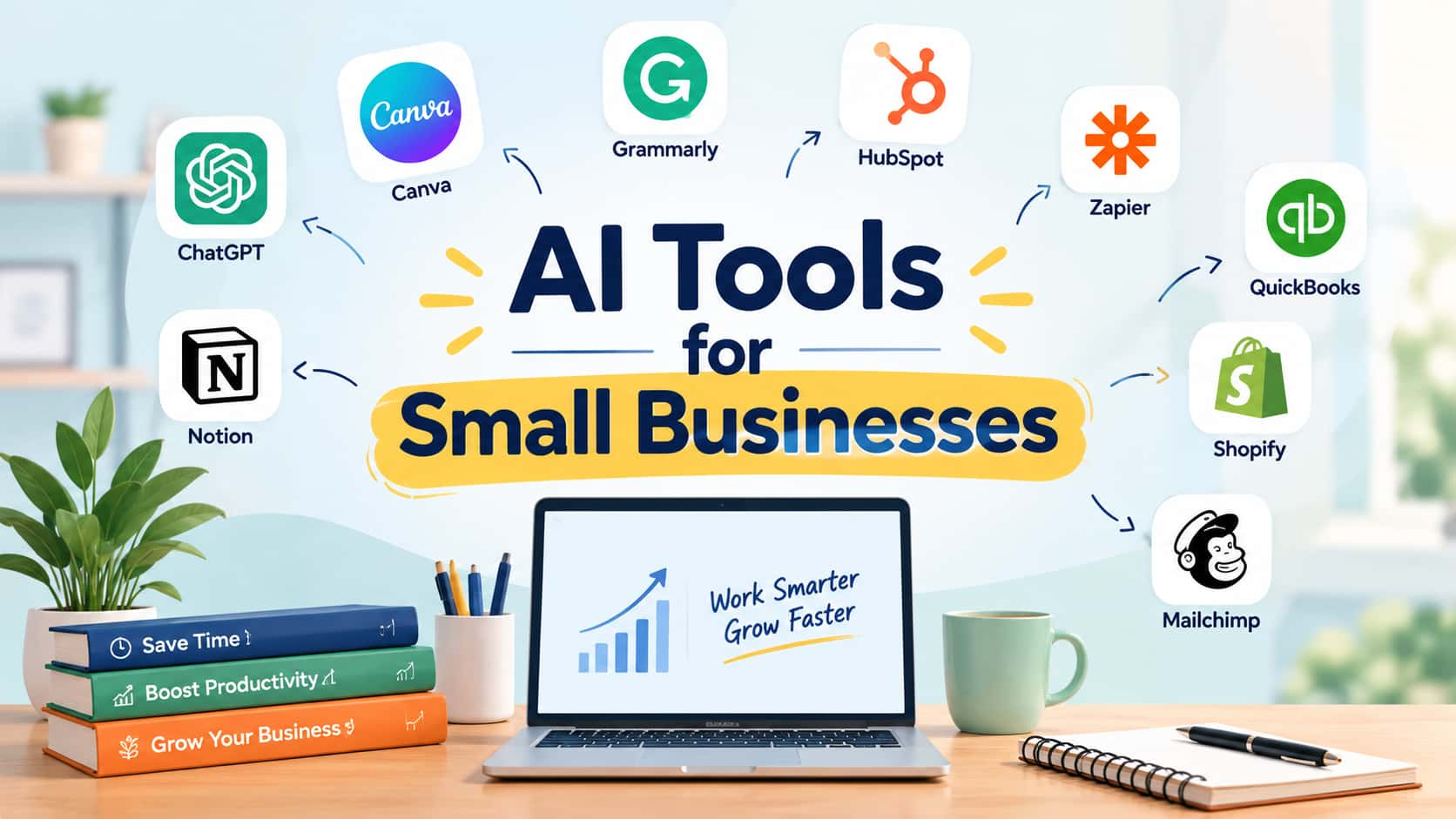
9 AI Tools Worth Considering in 2026
1. ChatGPT — Writing and Everyday Business Tasks
Empower Small Business Owners to maximize productivity using ChatGPT for writing, brainstorming, research and communication. Can be used to write emails, product descriptions, social media captions & marketing campaigns.
It can be used, for instance, by a small clothing company to create product descriptions for new items or to compose promotional texts for seasonal sales. The output can then be further customized to your brand tone, if you would like to do so.
Ideal for: Content Creation, Business Ideas and Personal Writing.
2. Canva AI — Marketing Designs and Visual Content
With Canva AI, marketing materials can be produced without a need for advanced graphic design skills. Depending on the plan and features, it might support visual creation, text generation and editing with the help of its AI features.
Canva is an excellent tool for small business to use when developing:
- Social media posts and social media banners.
- Planning and design of products (simple).
- Business materials and presentations for trade shows, conferences and exhibitions.
It comes in particularly handy for companies who want to have a nice look for the graphics, but aren’t able to afford a designer for every project.
Perfect for: Social media marketing, brand and promotional designs.
3. Grammarly — Clearer Business Communication
With Grammarly, you can correct your grammar, spelling, clarity and tone. The writing component can also be helpful in writing e-mail to customers, business proposals, website copy or working messages.
Business owners don’t need to spend more time going over each sentence individually; they can use Grammarly to make edits to their drafts before sending or publishing it. Certain higher-level AI capabilities might be available at a cost.
Best for: Writing e-mail, business writing, and proof reading.
4. HubSpot — Customer Relationships and Sales
HubSpot is a Customer Relationships and Sales system. HubSpot can help companies streamline their customer data, sales funnel, and customer interactions. Its CRM is equipped with marketing, sales, customer service tools and some of its products and plans include AI features.
You have the ability to follow up with prospects in HubSpot, log conversations and monitor them. This will be useful if there are multiple questions coming from multiple sources.
Great for: Customer Management, Lead Tracking and Sales follow-up.
5. Zapier — Automating Repetitive Tasks
Zapier links various apps together, and automates tasks that would otherwise have to be done by hand. The automation capabilities can help companies transfer information between tools, and build fewer lines of automation to build workflows.
For example, a business may create a workflow that would add new forms in a spreadsheet and alert the needed individual within the team. Automation features related to AI will vary depending on applications and plan.
Best suited to: Workflow automation, app connections and to decrease manual work.
6. QuickBooks — Bookkeeping and Financial Records
QuickBooks is designed for small businesses to keep track of their invoices, expenses, income and other finances. It also provides automation and AI-powered functionalities for specific accounting tasks, depending on the product and subscription.
It can be used by the owner of a business to make transactions, keep track of the cash flow and produce a financial report for evaluation. But still a check for important figures isn’t out of the question, particularly prior to tax filing.
Ideal for: Bookkeeping, financial organisation and invoice.
7. Shopify Magic – Online Store Content
Assists merchants who are eligible for Shopify to write product descriptions and other content for their stores.
- Can help with editing of content and some ecommerce features.
- Useful for the online retailer to have a more efficient product listing.
- Avoid using for: Ecommerce stores, product content.
8. Mailchimp — Email Marketing
- Assists with development of e-mail marketing campaigns, and their administration.
- Gives tools to control the audience and monitor the effectiveness of the campaigns.
- Ability to prepare sales e-mails and communications to customers for businesses.
Perfect for: e-mail marketing & Customer Communication.
9. Notion AI — Notes and Project Organization
- Summarises notes and organises written information using strategies
- May be able to assist in summarizing, planning and documentation.
- It is beneficial to have project information and team information in one workspace.
Perfect for: Project Management, Business notes and Team Organisation.
Which AI Tool Fits Your Business Best?
The appropriate AI tools for small businesses will depend on the amount of time that you have available to dedicate to a particular task. A freelancer may be required to take care of the writing and an online merchant may focus on the listings and putting their e-mail reply to customers. If you need to do a number of things, but you don’t subscribe to multiple, then do the most critical task first. Describe its importance and functions in a business in brief:
For marketing: You can utilize Canva AI to generate social media images and also make email projects with Mailchimp.
For writing and content: product descriptions, promotional text and even emails for businesses.ChatGPT can be used to create product descriptions, promotional content, and even business emails. Grammarly will scrutinize it and make it the best.
For customer management: HubSpot can take care of the customer details, sales leads and follow-ups.
For repetitive tasks: Zapier connects apps and automates routine workflows.
For accounting: QuickBooks sorts out the organization of invoices, costs, and monetary information.
Under special circumstances: Shopify Magic can assist the merchant to create product descriptions and store goods and contents in the online store.
To plan projects: Use Notion AI to plan and organize projects with notes, tasks and team info.
Let’s explore the price of These Tools
AI tools for small businesses can cost anything from free to costly, depending on the attributes it offers and the quantity of use and users. The tables are sorted by tool to enable business owners to compare costs of free and paid tools.
1. ChatGPT Pricing
| Plan | Price |
| Free | $0/month |
| Go | $8/month |
| Plus | $20/month |
| Business Standard | $20/user/month annually |
| Business Premium | $100/user/month annually |
| Enterprise | Custom pricing |
2. Canva AI Pricing
| Plan | Price |
| Free | $0 |
| Pro | $144/year |
| Business | $250/year per person |
| AI Pass | Additional cost |
3. Grammarly Pricing
| Plan | Price |
| Free | $0/month |
| Pro — Annual | $12/member/month |
| Pro — Monthly | $30/member/month |
4. HubSpot Pricing
| Plan | Price |
| Free | $0/month |
| Starter — Annual | Around $7/seat/month |
| Starter — Monthly | Around $20/seat/month |
| Professional | Varies |
| Enterprise | Custom pricing |
5. Zapier Pricing
| Plan | Price |
| Free | $0/month |
| Professional | Around $19.99/month |
| Team | Around $69/month |
6. QuickBooks Pricing
| Plan | Price |
| Solopreneur | 10–20/month |
| Simple Start | 19–38/month |
| Essentials | 42.50–75/month |
| Plus | 70–115/month |
| Advanced | 170–275/month |
7. Shopify Magic Pricing
| Plan | Price |
| Shopify Magic AI features | $0 additional fee |
| Shopify subscription | Varies by plan |
8. Mailchimp Pricing
| Plan | Price |
| Free | $0/month |
| Essentials | Around $13/month |
| Standard | Around $20/month |
| Premium | Around $350/month |
9. Notion AI Pricing
| Plan | Price |
| Free | $0/month |
| Plus | $10/member/month annually |
| Business | $20/member/month annually |
| Enterprise | Custom pricing |
| Notion Credits | $10 per 1,000 credits |
Common Mistakes Small Businesses Should Avoid
While AI tools for small businesses have the potential to save time for small businesses, the wrong tools or using the right tools at the wrong time or in the wrong way can lead to added workload. These are the errors to avoid to get the best performance out of the game.
- Too many tools at once: Begin with one or two tools which can address your largest business issues. Add additional as needed.
- Ignoring the free plan limits: If you’d like to subscribe, be sure to read the free plan limitations.
- Trusting every AI response: If all the information you hear from AI is factual, then it can provide false or incorrect information. Check facts, figures and recommendations before utilizing them.
- If the data security of the tool is sufficient: If you’re handling sensitive data, never share customer information, passwords, financial information or other personal information that isn’t secure enough for the tool.
- Expecting instant results: AI can support your work, but it still needs clear instructions, human review, and regular improvements.
- Forgetting your customers: Use the AI generated response and be helpful and relevant to your customers, even if you have an auto-reply.
Final Thoughts
Equipping small companies with the appropriate business AI tools for small businesses can streamline their processes, enhance customer engagement, and save time on tedious tasks. They can offer numerous benefits such as developing marketing material, handling cash and finances and even more. Whether you don’t need to spend a ton of money to get started or whether you don’t need to use all of the options, doesn’t matter. Make sure you have the right equipment for your business, test them and do not upgrade unless it’s strictly needed. When taken the right way, AI can enable your small business to run more efficiently and utilize its time and resources more effectively.