

AI Dangers: Find 10 Critical Risks and How to Manage Them
AI dangers can affect privacy, security, jobs, and daily life. Here are major risks & different ways to manage them safely before they cause serious problems.
When AI is in real life, is it safe? There is a risk of privacy violations, fake information, job loss and security concerns due to Artificial Intelligence. Risk can be unanticipated and impact people and organisations. Luckily, there are numerous that could be reduced if proper precautions are taken. From verifying AI-generated text to safeguarding one’s personal information, there are numerous small details that can prove to be very important.
What Is AI Danger?
The risks of AI Dangers are issues that might occur when artificial intelligence is applied without proper supervision or management. These AI Dangers risks can impact on their personal decisions, personal information, jobs, security, and privacy. While there are some risks with the use of AI because of its misinformation, there are others associated with its misuse by an individual or group. The effect could be different if technology is used and in what context it is used and what type of information is being manipulated. These risks are understandable and can be reduced and even audited AI-generated results and protected sensitive data.
For further visit this site: glaadvoice com
Go and Check thi also: AI voice scams
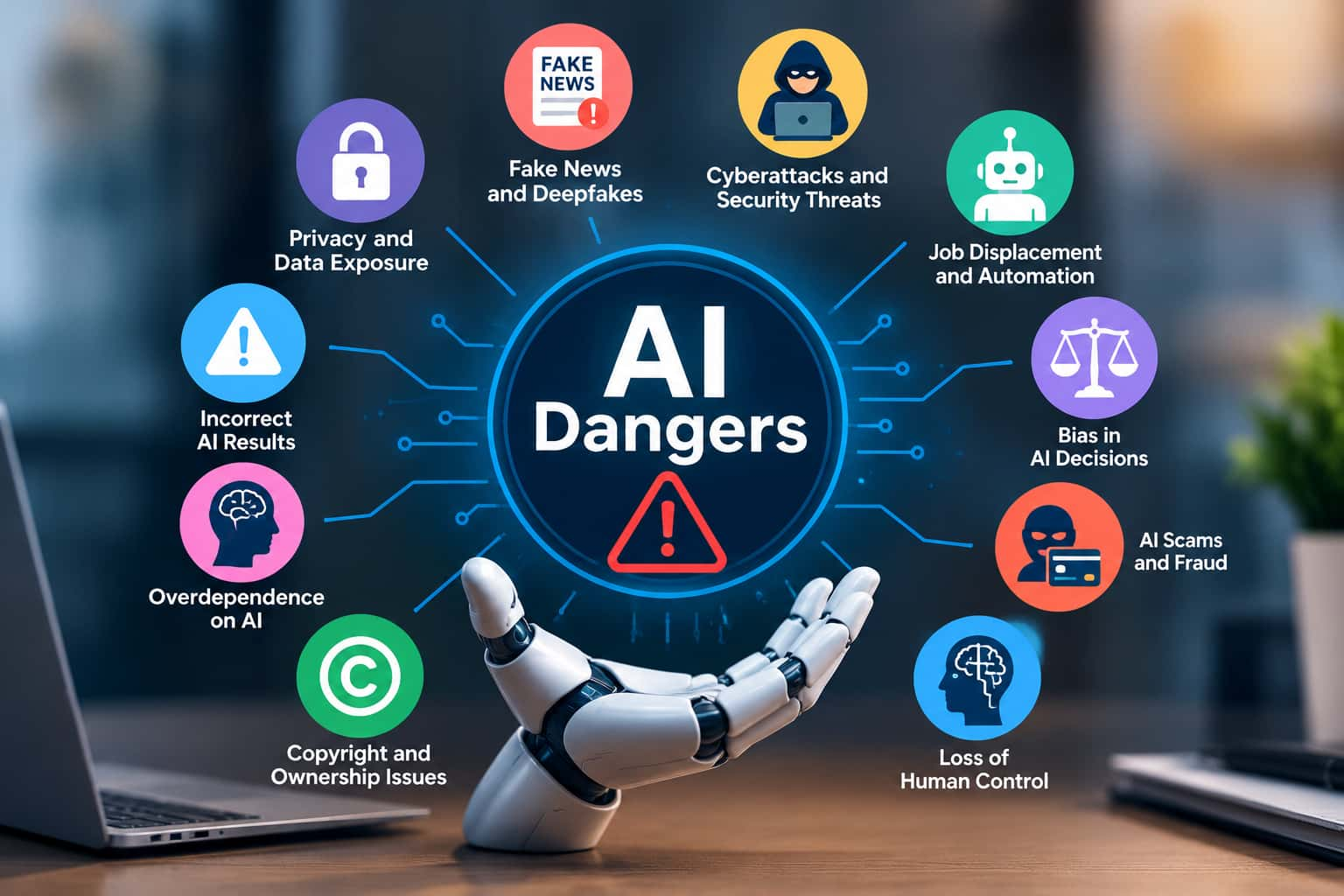
10 Major AI Dangers and Risks
1. Privacy and Data Exposure.
- Personal and confidential information can be processed using AI tools.
- Data protection policy may be an issue if you don’t know what theirs is.
- Only provide personal, financial or business information when it is required.
2. Fake News & Deepfakes
- AI can create deepfakes which can be inaccurate or misleading.
- Fake pictures and videos can be quite realistic.
- The information presented is subject to inaccuracies and may be generated by AI.
- Messages can be produced with a realistic voice with the help of Clone Voices.
- Information that’s important should always be double checked from reliable sources.
3. Security threats and cyberattacks.
- AI can be a force to bolster cybersecurity but can also be applied in cybercrime.
- It could be used to build a convincing phishing email, to make an automated attack or to enhance an attacker’s targeting.
- Managing security software and using strong passwords and multi-factor authentication will help to restrict access.
4. Displacement of jobs and automation
- Automation is transforming many of the professions.
- AI can execute some tasks, particularly repetitive ones, that would otherwise be carried out by human employees.
- Meanwhile, however, a large number of occupations are changing rather than becoming extinct.
- Acquiring capabilities that complement AI can aid employees adapt to the shifts.
5. Be mindful of bias in AI Decisions.
AI systems can be trained from data and perpetuate the patterns of bias that exist within the data. This AI Dangers may impact the recommendations, lending, recruitment and other decisions. Human review is critical when automated decisions have the potential to impact an individual’s opportunities.
6. AI Art and AI Writing
With AI assistance, some frauds have become more elusive to detect. The voices can be repeated to make an echo sound. AI-generated photos can be leveraged for fake accounts.These fake accounts can be created using AI-generated photos. Personalized messages might feel like it’s from someone who is known to you. If it is an unusual request, it should always be confirmed using another means.
7. Human Control Loss.
- It’s important to remember that AI can’t always be a catch-all solution.
- An answer to a machine might be correct but it may be incorrect.
- The more someone is involved in the decision making process, the more judgment and accountability is added.
8. Copyright and Ownership issues
AI-generated content may include queries about the authorship of the final product.Another issue can be if the material created is too similar to the content that already exists. The copyright of AI-generated content should be verified before publishing and/or commercialization.
9. Overdependence on AI
Human beings might find their independent thinking impacted with the regular work done by AI.
- Individuals could cease to look into data from other sources.
- Less practice in writing and researching skills may be obtained.
- Automated suggestions can have too strong of an impact on creative decisions.
- While AI is a tool to assist, not to replace, human involvement.
10. Incorrect AI Results
AI may give the wrong answer even if it’s making a confident statement. It can misinterpret a question, only access a small amount of information or give out information that is outdated. When deciding on medical, financial, legal or other major issues, it is always important to check for important information.
How to Manage AI Dangers Risks
The first step to AI Dangers risks is to be Careful with its use instead of taking it on faith.
Do not use private information: Don’t share passwords, financial information or other private information with AI tools.
Have key information correct: Fact check from reliable and independent sources.
Secure accounts: Ensure that accounts are secured with strong passwords and multi-factor authentication.
Human oversight of AI decisions: Review of decisions made by AI, especially financial, employment, privacy/personal decisions.
Use trusted tools: Be sure to research the platform’s security measures and privacy policies prior to use.
When using AI output: Take care not to take AI-generated output for granted but use it as a guide or helper.
Update software: Ensure software is kept up to date to identify and patch security vulnerabilities and to make the software more secure.
Who Faces The Most Riks?
Anyone can be impacted by the risks from AI, but there may be groups that are more vulnerable as a result of their engagement with AI.
- Everyday users
- Businesses
- Students and professionals
- Children/young people without supervision.
- Sensitive-data users
Need to be checked before using AI
To mitigate risk, there are some simple security checks they need to make before utilizing an AI tool.
- Privacy Policy: Review information collected by the tool and how it is used.
- Data security: Make sure that data security measures are in place that will help protect your data.
- Accuracy: Ensure that the tool provides accurate and verifiable results.
- Permissions: Review permissions that the tool wants to grant to your device and/or account.
- Educational content: Discuss guidelines on how to use AI-generated content.
Final Thoughts
It is crucial to not overlook the risks involved in using AI to streamline and enhance productivity in various tasks. If not appropriately used, it could pose serious problems in regard to privacy, incorrect contents, scams, security and misinformation. It is best to stay alert, protect personal information, verify key information and do not rely on information entirely. Properly using AI can help people reap its rewards while minimizing unwarranted risks.




2 Comments